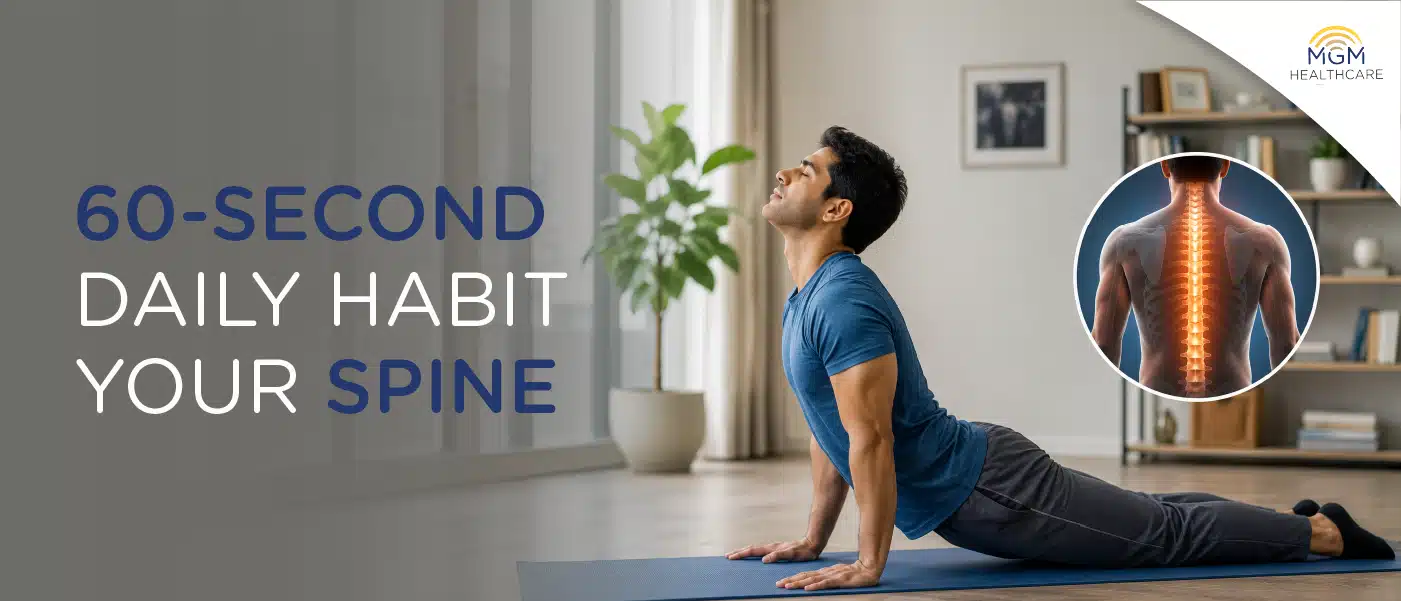
Sit for hours every day? Your back may be asking you to move.
If you spend most of your day sitting at a desk, driving, studying, working on a computer or scrolling on your phone, you may notice the same problem by the end of the day:
A stiff, tired or uncomfortable back.
The answer isn’t necessarily to sit with a perfectly straight back all day.
One of the simplest things you can do is move regularly.
A 60-second movement break gives you a reason to get out of your chair, change position and move your body after sitting for a long time.
It takes only a minute.
And while that minute is not a treatment for back pain or a replacement for exercise, making movement a regular part of your day can help you avoid sitting still for hours at a time.
It is exactly what it sounds like: a short movement break during your day.
When you’ve been sitting for a while, get up and move for about a minute.
You could:
You don’t need a gym, equipment or special clothing.
The idea is simply:
Sit → Get up → Move → Get back to work.
If a particular movement causes pain, stop rather than forcing through it.
Your body is designed to move, not stay in one position for most of the day.
When you spend hours sitting without changing position, you may notice stiffness or discomfort, particularly if you are also not physically active.
Regular movement breaks can help you:
The goal isn’t to find one perfect sitting position.
The goal is to avoid staying in the same position for too long.
This can be difficult when your work involves a computer.
You may sit down in the morning and suddenly realise that several hours have passed.
Try making movement part of your normal workday.
For example:
After finishing a task: stand up and move.
During a phone call: walk around if practical.
After a long meeting: get up before starting your next task.
During screen breaks: use some of that time to walk instead of continuing to sit.
You can also set a simple reminder if you regularly lose track of time.
You don’t have to stop working for a long exercise session.
Sometimes, one minute is enough to remind you that it’s time to move.
Not by itself.
This is important.
A 60-second movement break is a useful habit for breaking up prolonged sitting, but it shouldn’t replace regular physical activity.
For overall health, adults should aim for regular aerobic activity and muscle-strengthening activity each week, according to their individual health and fitness level.
Your regular activity might include:
If you already have a back or spine condition, speak with your doctor or physiotherapist about which exercises are appropriate for you.
Not really.
Many people worry about sitting perfectly straight all day.
But staying in any one position for too long can become uncomfortable.
Instead of constantly trying to correct your posture, focus on:
Think of posture as something that can change, rather than a position you have to hold perfectly.
This habit can be particularly useful if you:
And you don’t need to have back pain to benefit from becoming more active.
It’s easier to build the habit before discomfort becomes a daily problem.
Your spine needs more than one minute of movement.
Along with taking regular movement breaks, try to:
If you have back pain that keeps returning, don’t simply keep stretching and hoping it goes away. The underlying cause may need to be assessed.
Not every episode of back stiffness requires medical attention.
But you should speak with a healthcare professional if your back pain:
A medical evaluation can help determine whether your symptoms are related to muscles, joints, nerves, the spine or another condition.
Some symptoms should not be managed with exercise or stretching at home.
Seek urgent medical attention if back pain occurs with:
These symptoms can indicate a serious problem affecting the nerves or spine and require prompt assessment.
You don’t need to completely change your routine.
The next time you realise you’ve been sitting for a long time:
Stand up.
Move gently.
Walk for a few moments.
Then get back to what you were doing.
Do it again the next time you’ve been sitting for too long.
Over time, these small movement breaks can become part of your normal routine.
Just remember: the 60-second habit is a starting point, not the whole solution. Your spine and overall health also benefit from regular physical activity, strength, mobility and healthy daily habits.
“Your spine does not need you to maintain one perfect posture all day. It needs regular movement. A short movement break is a simple way to interrupt prolonged sitting, but it should be combined with regular physical activity and appropriate strengthening and mobility exercises. If back pain persists or worsens, it is important to identify the underlying cause rather than simply stretching through it.”
Back pain or stiffness keeps coming back?
A short movement break can be a useful daily habit, but persistent back pain may have an underlying cause that needs professional evaluation.
At MGM Healthcare, our specialists can assess your back and spine symptoms, identify the possible cause and recommend an appropriate treatment, rehabilitation or exercise plan based on your condition.
Don’t keep pushing through persistent back pain. Book an appointment with our specialists and get the right evaluation.
A one-minute movement break is a useful way to interrupt prolonged sitting, but it is not enough on its own. Regular physical activity, strengthening and mobility exercises are also important.
There is no single schedule that works for everyone. If you sit for long periods, try to change position and move regularly rather than remaining seated continuously for several hours.
Long periods in the same position can contribute to stiffness and discomfort in some people. Regular movement and physical activity can help reduce prolonged sedentary time.
There is no single best exercise for everyone. Walking, strengthening, mobility and flexibility exercises can all be useful depending on your health, fitness level and any existing condition.
See a healthcare professional if your back pain is persistent, recurrent, worsening or affecting your daily activities, particularly if you also have leg pain, numbness, tingling or weakness.