AMH Normal Range by Age: Normal AMH Levels Explained AMH Normal Range by Age: Normal AMH Levels Explained

AMH Normal Range by Age: What Is a Normal AMH Level? Wed , Jun 26

About the Health Information

Our Health information will help you stay up to date on what is happening in health care. We bring you news/information/perspectives around health care innovations, preventive medicine, early diagnosis, nutrition and diet, women’s health, men’s health, children’s health, latest technologies, treatments and surgeries, diseases and conditions, fitness and more.


Popular Posts
Medical Emergency Mon , Dec 27
Shoulder Arthritis and its types

  • Published: July 2026
    Last Medically Reviewed: July 2026
    Reading Time: 5 Minutes

Quick Facts

    • AMH helps estimate the number of eggs remaining in the ovaries.
    • A normal AMH level varies with age.
    • Low or high AMH levels do not always determine fertility.
    • AMH results should be interpreted along with other fertility tests.
    • A fertility specialist can help you understand your AMH report.

Introduction

  • If you’ve recently had an AMH test, you may be wondering whether your result is normal. It’s natural to feel concerned after seeing your AMH value, especially if you’re planning a pregnancy. However, one test result doesn’t tell the complete story.

  • Knowing the normal AMH range for your age can help you better understand your fertility and discuss the next steps with your doctor.

What Is AMH?

  • AMH (Anti-Müllerian Hormone) is a hormone produced by the small follicles in the ovaries. Doctors use the AMH test to estimate your ovarian reserve, which refers to the number of eggs remaining in the ovaries. While AMH provides useful information about ovarian reserve, it does not measure egg quality or confirm whether you can become pregnant.

What Is the Normal AMH Range?

  • There is no single AMH value that is considered normal for every woman. In general, an AMH level between 1.0 and 3.5 ng/mL is considered normal for many women of reproductive age. However, the expected range changes naturally as you get older.

    Your doctor will also consider:

    • Your age
    • Menstrual cycle
    • Medical history
    • Ultrasound findings
    • Other hormone test results

    before interpreting your AMH level.

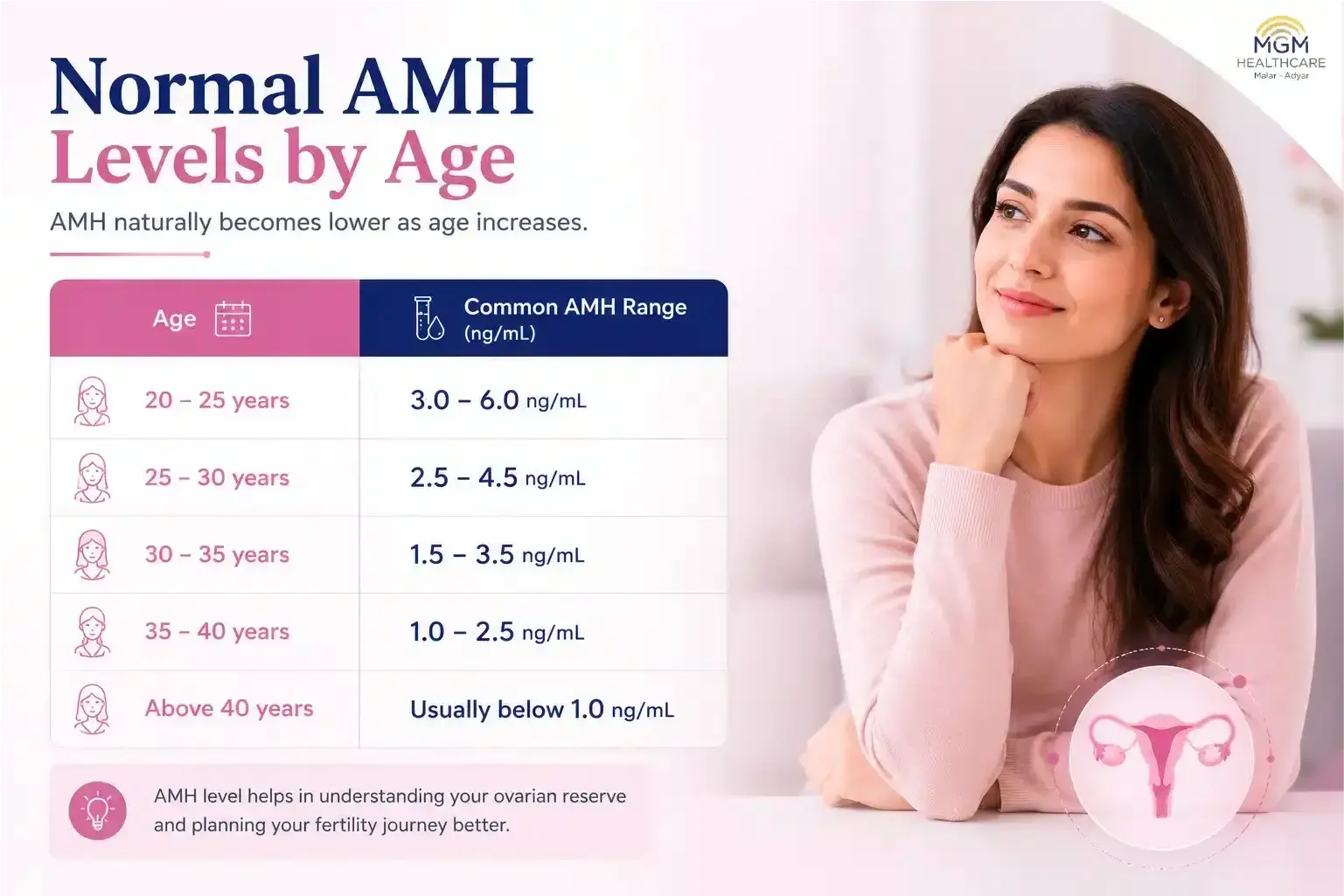
AMH Normal Range by Age

  • As women age, AMH levels gradually decrease because the number of eggs in the ovaries naturally declines.


    Age Common AMH Range
    20 – 25 years 3.0 – 6.0 ng/mL
    25 – 30 years 2.5 – 4.5 ng/mL 
    30 – 35 years 1.5 – 3.5 ng/mL
    35 – 40 years 1.0 – 2.5 ng/mL
    Above 40 years Usually below 1.0 ng/mL


    These values are approximate and may vary between laboratories.

What Does a Low AMH Level Mean?

  • A low AMH level usually means your ovarian reserve is lower than expected for your age. However, low AMH does not always mean infertility. Many women with low AMH continue to ovulate regularly and may conceive naturally or with fertility treatment.

Does a Normal AMH Level Mean You Can Get Pregnant?

  • Not necessarily.
    A normal AMH level suggests that your ovarian reserve is appropriate for your age, but pregnancy also depends on:

    • Egg quality
    • Ovulation
    • Fallopian tubes
    • Sperm health
    • Overall reproductive health

    This is why AMH is only one part of a complete fertility assessment.

When Is an AMH Test Recommended?

  • Your doctor may advise an AMH test if you:

    • Are planning a pregnancy
    • Have difficulty conceiving
    • Have irregular periods
    • Are considering IVF treatment
    • Want to preserve your fertility through egg freezing

When Should You See a Fertility Specialist?

  • Consult a fertility specialist if you:

    • Have an abnormal AMH result
    • Have been trying to conceive without success
    • Have irregular menstrual cycles
    • Are over 35 years and planning pregnancy
    • Want to understand your fertility options

    Early guidance can help you make informed decisions about your reproductive health.

Key Takeaways

    • AMH levels naturally change with age.
    • A normal AMH range is different for every woman.
    • Low or high AMH levels do not determine fertility on their own.
    • Your AMH result should always be interpreted along with other fertility tests.
    • A fertility specialist can help explain your report and recommend the right next steps.

Conclusion

  • An AMH test offers valuable information about your ovarian reserve, but it is only one part of understanding your fertility.

  • Instead of focusing on a single number, it’s important to consider your age, menstrual health, and overall reproductive health. If you have questions about your AMH result, consult a fertility specialist for personalised advice and guidance.

Frequently Asked Questions

What is the normal AMH range?

For many women of reproductive age, an AMH level between 1.0 and 3.5 ng/mL is commonly considered normal. The expected range varies with age.

Does AMH decrease with age?

Yes. AMH levels gradually decrease as women get older because the ovarian reserve naturally declines.

Can I get pregnant if my AMH is low?

Yes. Many women with low AMH conceive naturally or with fertility treatment, depending on their overall reproductive health.

Is a high AMH level always a concern?

No. High AMH levels may be associated with PCOS, but they do not always indicate a medical problem.

Does a normal AMH level guarantee pregnancy?

No. A normal AMH level reflects ovarian reserve, but pregnancy also depends on factors such as egg quality, ovulation, sperm health, and overall reproductive health.